Download Mendeley
Structural basis of glucosinolate recognition and polyspecific transport by the glucosinolate transporter GTR1.
Nan, J., Xu, H., Kang, S., Xie, G., Zhao, J., Li, S.(2026) J Biol Chem 302: 113190-113190
- PubMed: 42184857 Search on PubMedSearch on PubMed Central
- DOI: https://doi.org/10.1016/j.jbc.2026.113190
- Primary Citation Related Structures:
23CN, 23CZ, 23DA, 23DB - PubMed Abstract:
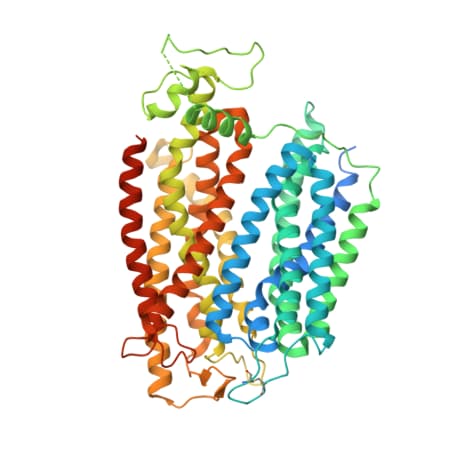
Glucosinolates (GLSs) are sulfur-rich secondary metabolites characteristic of Brassicales and play central roles in plant defense. While the biosynthesis and long-distance allocation of GLSs have been extensively studied, the molecular principles underlying their membrane transport by Glucosinolate Transporters (GTRs) remain poorly understood. Here, we report cryogenic electron microscopy (cryo-EM) structures of Arabidopsis thaliana GTR1 (AtGTR1) in apo and substrate-bound states. Structures of AtGTR1 in complex with the glucobrassicin (3-indolylmethyl glucosinolate, I3M), were determined at two pH conditions, capturing the transporter in a conserved inward-open conformation. The structures reveal a central substrate-binding cavity formed at the interface of the N- and C-terminal domains. Structural analyses uncover a conserved recognition strategy in which AtGTR1 selectively engages the common glucosinolate scaffold while tolerating substantial variation in side chains, thereby explaining its polyspecificity. These findings establish a structural framework for GTRs and provide mechanistic insights that enable rational manipulation of GLSs allocation for crop improvement.
- International Cancer Center, Guangdong Key Laboratory of Genome Instability and Human Disease Prevention, Department of Biochemistry and Molecular Biology, Shenzhen University Medical School, Shenzhen, Guangdong, China.
Organizational Affiliation: