3P0G | pdb_00003p0g

Structure of a nanobody-stabilized active state of the beta2 adrenoceptor


Experimental Data Snapshot

  • Method: X-RAY DIFFRACTION
  • Resolution: 3.50 Å
  • R-Value Free: 
    0.308 (Depositor) 
  • R-Value Work: 
    0.235 (Depositor) 
  • R-Value Observed: 
    0.243 (Depositor) 

Starting Models: experimental
View more details

wwPDB Validation 3D Report Full Report

Validation slider image for 3P0G

Ligand Structure Quality Assessment 


This is version 1.5 of the entry. See complete history

Literature

Structure of a nanobody-stabilized active state of the b2 adrenoceptor

Rasmussen, S.G.Choi, H.J.Fung, J.J.Pardon, E.Casarosa, P.Chae, P.S.Devree, B.T.Rosenbaum, D.M.Thian, F.S.Kobilka, T.S.Schnapp, A.Konetzki, I.Sunahara, R.K.Gellman, S.H.Pautsch, A.Steyaert, J.Weis, W.I.Kobilka, B.K.

(2011) Nature 469: 175-180

  • DOI: https://doi.org/10.1038/nature09648
  • Primary Citation Related Structures: 
    3P0G

  • PubMed Abstract: 

    G protein coupled receptors (GPCRs) exhibit a spectrum of functional behaviours in response to natural and synthetic ligands. Recent crystal structures provide insights into inactive states of several GPCRs. Efforts to obtain an agonist-bound active-state GPCR structure have proven difficult due to the inherent instability of this state in the absence of a G protein. We generated a camelid antibody fragment (nanobody) to the human β(2) adrenergic receptor (β(2)AR) that exhibits G protein-like behaviour, and obtained an agonist-bound, active-state crystal structure of the receptor-nanobody complex. Comparison with the inactive β(2)AR structure reveals subtle changes in the binding pocket; however, these small changes are associated with an 11 Å outward movement of the cytoplasmic end of transmembrane segment 6, and rearrangements of transmembrane segments 5 and 7 that are remarkably similar to those observed in opsin, an active form of rhodopsin. This structure provides insights into the process of agonist binding and activation.


  • Organizational Affiliation
    • Department of Molecular and Cellular Physiology, Stanford University School of Medicine, 279 Campus Drive, Stanford, California 94305, USA.

Macromolecule Content 

  • Total Structure Weight: 70.87 kDa 
  • Atom Count: 3,238 
  • Modeled Residue Count: 405 
  • Deposited Residue Count: 627 
  • Unique protein chains: 2

Macromolecules

Find similar proteins by:|  3D Structure
Entity ID: 1
MoleculeChains  Sequence LengthOrganismDetailsImage
Beta-2 adrenergic receptor, Lysozyme501Homo sapiensTequatrovirus T4Mutation(s): 1 
Gene Names: ADRB2ADRB2RB2ARE
EC: 3.2.1.17
Membrane Entity: Yes 
UniProt & NIH Common Fund Data Resources
Find proteins for P00720 (Enterobacteria phage T4)
Explore P00720 
Go to UniProtKB:  P00720
Find proteins for P07550 (Homo sapiens)
Explore P07550 
Go to UniProtKB:  P07550
PHAROS:  P07550
GTEx:  ENSG00000169252 
Entity Groups
Sequence Clusters30% Identity50% Identity70% Identity90% Identity95% Identity100% Identity
UniProt GroupsP00720P07550
Sequence Annotations
Expand
Reference Sequence
Find similar proteins by:|  3D Structure
Entity ID: 2
MoleculeChains  Sequence LengthOrganismDetailsImage
Camelid Antibody Fragment126Lama glamaMutation(s): 0 

Small Molecules

Ligands 1 Unique
IDChains Name / Formula / InChI Key2D Diagram3D Interactions
P0G

Query on P0G


Download:Ideal Coordinates CCD File
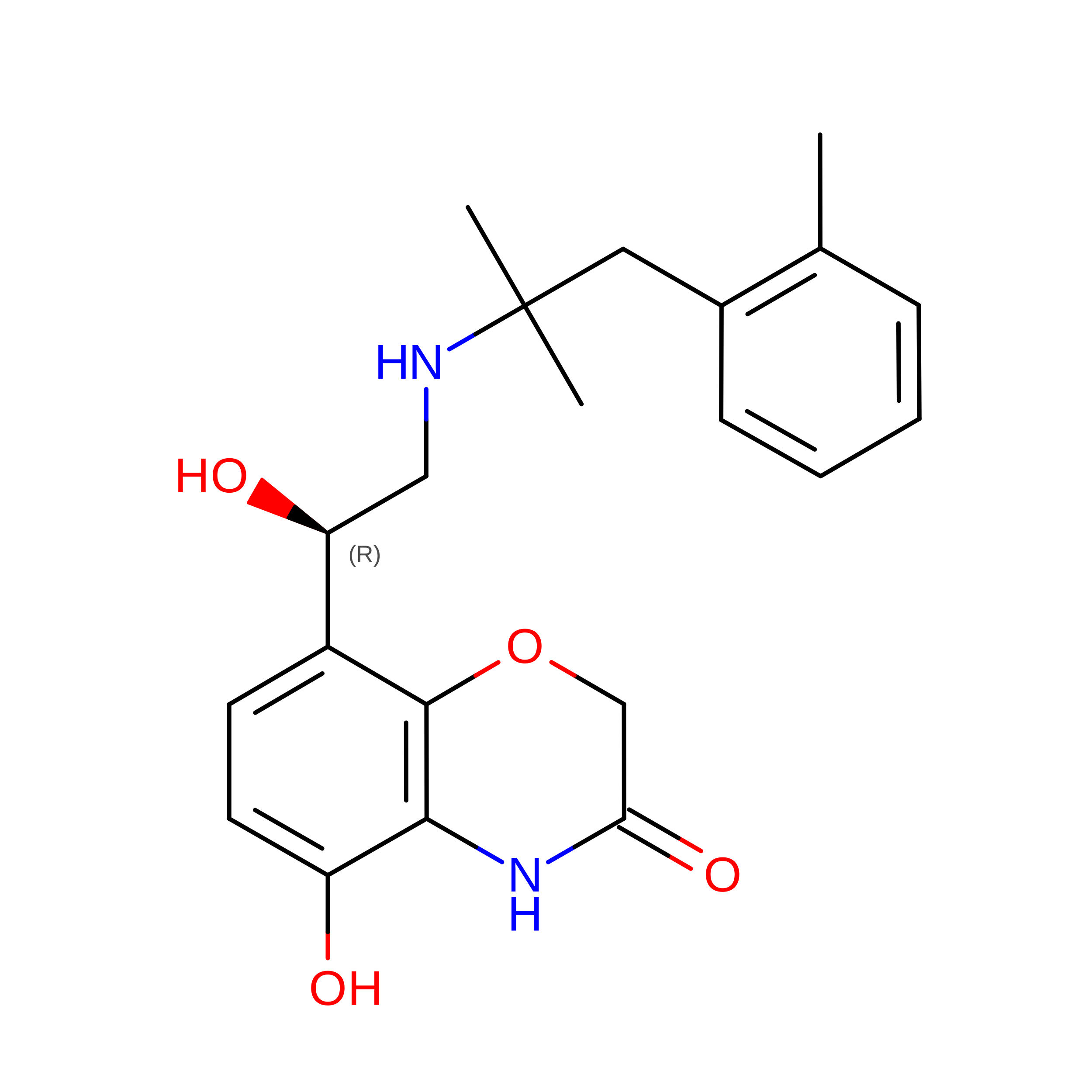
C [auth A]8-[(1R)-2-{[1,1-dimethyl-2-(2-methylphenyl)ethyl]amino}-1-hydroxyethyl]-5-hydroxy-2H-1,4-benzoxazin-3(4H)-one
C21 H26 N2 O4
NWQXBEWHTDRJIP-KRWDZBQOSA-N

Experimental Data & Validation

Experimental Data

  • Method: X-RAY DIFFRACTION
  • Resolution: 3.50 Å
  • R-Value Free:  0.308 (Depositor) 
  • R-Value Work:  0.235 (Depositor) 
  • R-Value Observed: 0.243 (Depositor) 
Space Group: C 1 2 1
Unit Cell:
Length ( Å )Angle ( ˚ )
a = 236.686α = 90
b = 45.66β = 102.34
c = 71.375γ = 90
Software Package:
Software NamePurpose
BUSTER-TNTrefinement
PDB_EXTRACTdata extraction
Blu-Icedata collection
HKL-2000data reduction
SCALEPACKdata scaling
PHASERphasing
BUSTERrefinement

Structure Validation

View Full Validation Report


Ligand Structure Quality Assessment 


Entry History 

Revision History  (Full details and data files)

  • Version 1.0: 2011-01-19
    Type: Initial release
  • Version 1.1: 2011-07-13
    Changes: Version format compliance
  • Version 1.2: 2017-08-23
    Changes: Source and taxonomy
  • Version 1.3: 2017-11-08
    Changes: Refinement description
  • Version 1.4: 2023-09-06
    Changes: Data collection, Database references, Derived calculations, Refinement description
  • Version 1.5: 2024-10-30
    Changes: Structure summary