1GIA | pdb_00001gia

STRUCTURE OF ACTIVE CONFORMATIONS OF GIA1 AND THE MECHANISM OF GTP HYDROLYSIS


Experimental Data Snapshot

  • Method: X-RAY DIFFRACTION
  • Resolution: 2.00 Å
  • R-Value Free: 
    0.228 (Depositor) 
  • R-Value Work: 
    0.175 (Depositor) 
  • R-Value Observed: 
    0.175 (Depositor) 

wwPDB Validation 3D Report Full Report

Validation slider image for 1GIA

This is version 1.3 of the entry. See complete history

Literature

Structures of active conformations of Gi alpha 1 and the mechanism of GTP hydrolysis.

Coleman, D.E.Berghuis, A.M.Lee, E.Linder, M.E.Gilman, A.G.Sprang, S.R.

(1994) Science 265: 1405-1412

  • DOI: https://doi.org/10.1126/science.8073283
  • Primary Citation Related Structures: 
    1GFI, 1GIA, 1GIL

  • PubMed Abstract: 

    Mechanisms of guanosine triphosphate (GTP) hydrolysis by members of the G protein alpha subunit-p21ras superfamily of guanosine triphosphatases have been studied extensively but have not been well understood. High-resolution x-ray structures of the GTP gamma S and GDP.AlF4- complexes formed by the G protein Gi alpha 1 demonstrate specific roles in transition-state stabilization for two highly conserved residues. Glutamine204 (Gln61 in p21ras) stabilizes and orients the hydrolytic water in the trigonal-bipyramidal transition state. Arginine 178 stabilizes the negative charge at the equatorial oxygen atoms of the pentacoordinate phosphate intermediate. Conserved only in the G alpha family, this residue may account for the higher hydrolytic rate of G alpha proteins relative to those of the p21ras family members. The fold of Gi alpha 1 differs from that of the homologous Gt alpha subunit in the conformation of a helix-loop sequence located in the alpha-helical domain that is characteristic of these proteins; this site may participate in effector binding. The amino-terminal 33 residues are disordered in GTP gamma S-Gi alpha 1, suggesting a mechanism that may promote release of the beta gamma subunit complex when the alpha subunit is activated by GTP.


  • Organizational Affiliation
    • Howard Hughes Medical Institute, Dallas, TX.

Macromolecule Content 

  • Total Structure Weight: 40.83 kDa 
  • Atom Count: 2,649 
  • Modeled Residue Count: 310 
  • Deposited Residue Count: 353 
  • Unique protein chains: 1

Macromolecules

Find similar proteins by:|  3D Structure
Entity ID: 1
MoleculeChains  Sequence LengthOrganismDetailsImage
G PROTEIN GI ALPHA 1353Rattus norvegicusMutation(s): 0 
EC: 3.6.5
UniProt
Find proteins for P10824 (Rattus norvegicus)
Explore P10824 
Go to UniProtKB:  P10824
Entity Groups
Sequence Clusters30% Identity50% Identity70% Identity90% Identity95% Identity100% Identity
UniProt GroupP10824
Sequence Annotations
Expand
Reference Sequence

Small Molecules

Ligands 2 Unique
IDChains Name / Formula / InChI Key2D Diagram3D Interactions
GSP

Query on GSP


Download:Ideal Coordinates CCD File
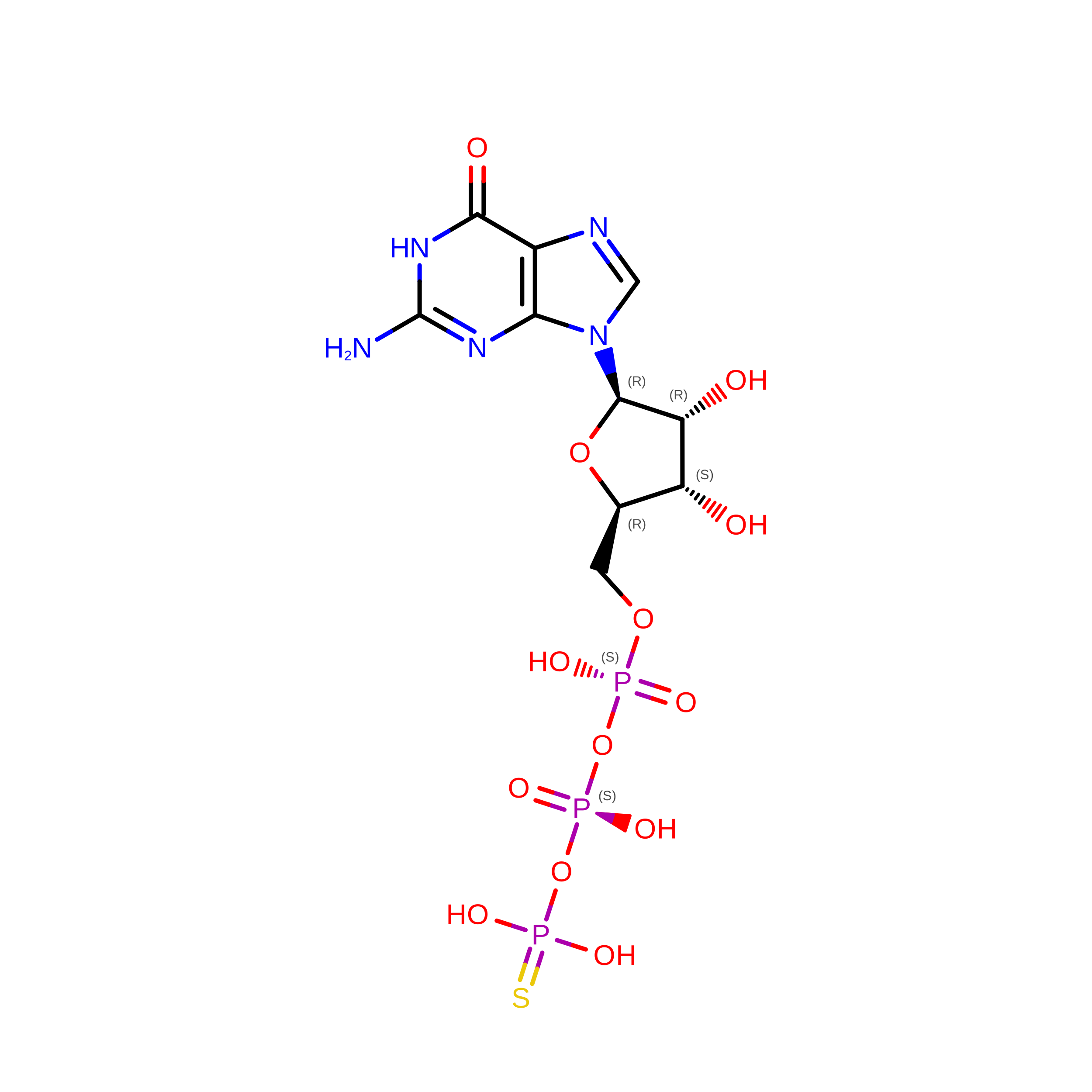
C [auth A]5'-GUANOSINE-DIPHOSPHATE-MONOTHIOPHOSPHATE
C10 H16 N5 O13 P3 S
XOFLBQFBSOEHOG-UUOKFMHZSA-N
MG

Query on MG


Download:Ideal Coordinates CCD File
B [auth A]MAGNESIUM ION
Mg
JLVVSXFLKOJNIY-UHFFFAOYSA-N

Experimental Data & Validation

Experimental Data

  • Method: X-RAY DIFFRACTION
  • Resolution: 2.00 Å
  • R-Value Free:  0.228 (Depositor) 
  • R-Value Work:  0.175 (Depositor) 
  • R-Value Observed: 0.175 (Depositor) 
Space Group: P 32 2 1
Unit Cell:
Length ( Å )Angle ( ˚ )
a = 80.6α = 90
b = 80.6β = 90
c = 106.5γ = 120
Software Package:
Software NamePurpose
X-PLORmodel building
X-PLORrefinement
X-PLORphasing

Structure Validation

View Full Validation Report


Entry History 

Deposition Data

Revision History  (Full details and data files)

  • Version 1.0: 1994-09-30
    Type: Initial release
  • Version 1.1: 2008-03-24
    Changes: Version format compliance
  • Version 1.2: 2011-07-13
    Changes: Version format compliance
  • Version 1.3: 2024-02-07
    Changes: Data collection, Database references, Derived calculations, Other