Download Mendeley
Structure-guided surface engineering to improve the catalytic activity of ethylene-forming enzyme.
Wang, M., Shen, Z., Wu, L., Huang, W., Zhou, J., Gu, Y.(2026) Eng Microbiol 6: 100276-100276
- PubMed: 42238545 Search on PubMedSearch on PubMed Central
- DOI: https://doi.org/10.1016/j.engmic.2026.100276
- Primary Citation Related Structures:
22NW, 22PE - PubMed Abstract:
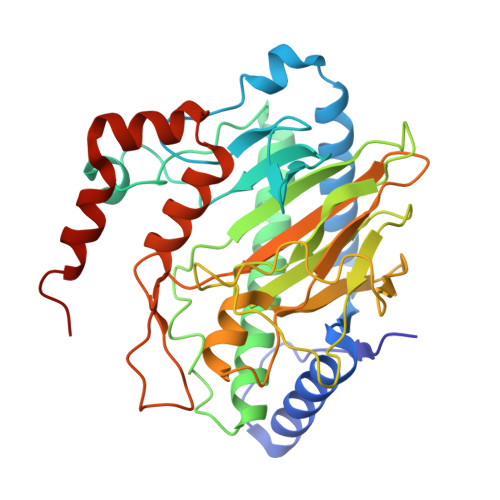
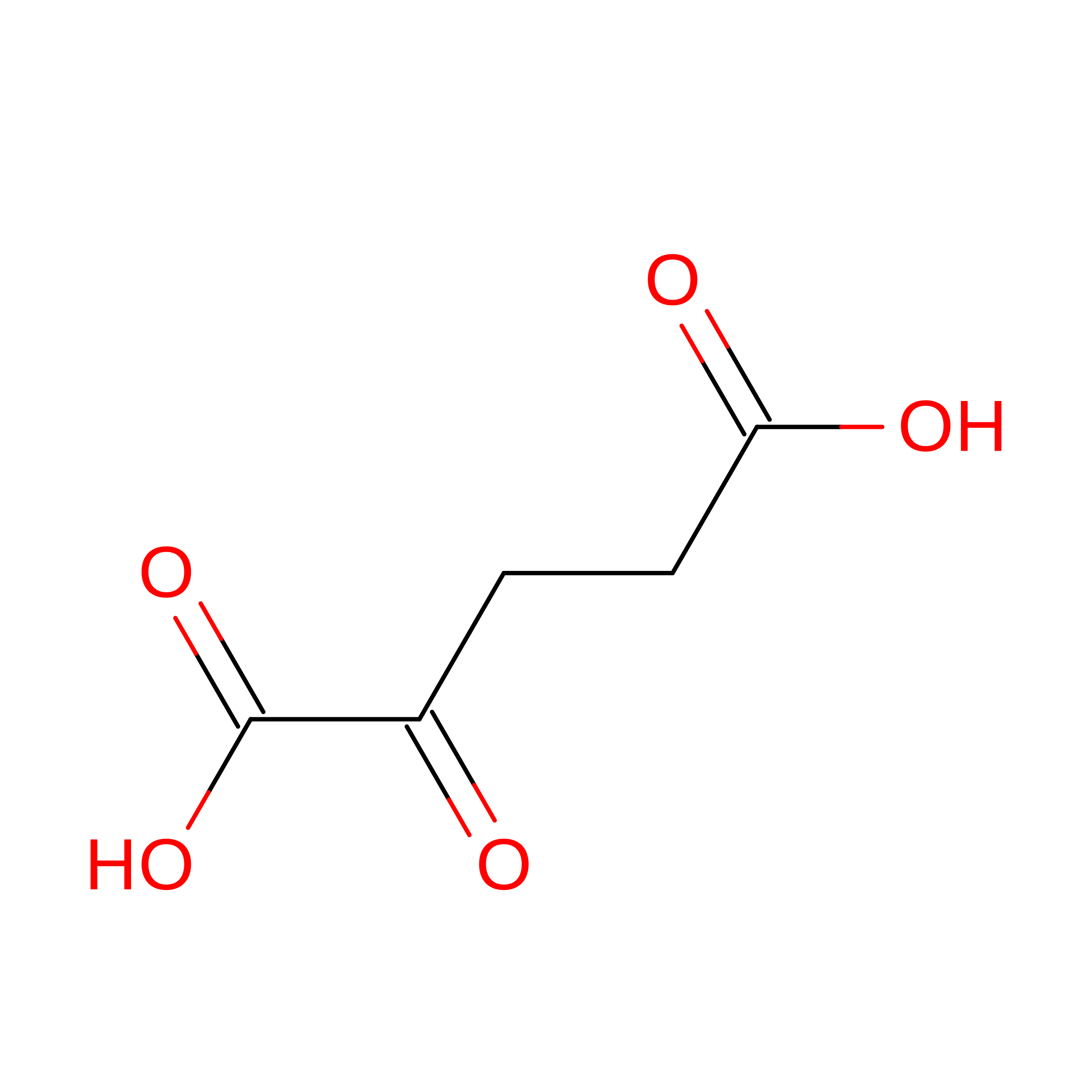
The ethylene-forming enzyme (EFE) is a member of the mononuclear non-heme Fe(II)- and 2-oxoglutarate-dependent oxygenase superfamily, which can oxidize 2-oxoglutarate to form ethylene in an arginine-dependent reaction. While significant enzyme engineering efforts have targeted the active site and surface of EFE, to date, no variant with substantially improved activity has been reported. To enhance catalytic activity and broaden the application potential of EFE, this study developed a surface engineering strategy based on structural analysis and potentially new l-Arg binding information. The resulting variant, E213T, exhibited a 1.5-fold increase in catalytic activity and a 2.4-fold elevation in k cat, l-Arg . Molecular dynamics simulations further revealed that this amino acid substitution reduced the affinity of the surface l-Arg binding site and altered the accessibility of ligands to the catalytic center. Our study provides a new perspective on the distal sites and functional relationships in protein engineering of EFE.
- Shenzhen Institutes of Advanced Technology, Chinese Academy of Sciences, Shenzhen 518055, China.
Organizational Affiliation: