23AY | pdb_000023ay

CryoEM structure of EV-D68 US/MO/14-18947 mature virion

  • Classification: VIRUS
  • Organism(s): enterovirus D68
  • Expression System: Homo sapiens
  • Mutation(s): No 

  • Deposited: 2026-01-30 Released: 2026-09-09 
  • Deposition Author(s): Liang, S.J., Lou, Z.Y.
  • Funding Organization(s): National Natural Science Foundation of China (NSFC)

Experimental Data Snapshot

  • Method: ELECTRON MICROSCOPY
  • Resolution: 2.27 Å
  • Aggregation State: PARTICLE 
  • Reconstruction Method: SINGLE PARTICLE 

wwPDB Validation

Currently 23AY does not have a validation slider image.


This is version 1.0 of the entry. See complete history

Literature

A dual-receptor checkpoint primes enterovirus D68 for respiratory cell entry.

Liang, S.Guo, H.Xu, Z.Liu, Z.Yang, W.Liu, X.Wei, Z.Hou, J.Huang, W.Wang, W.Li, J.Ma, W.Deng, Z.Qian, H.Wang, Y.Liu, J.Rao, Z.Wei, W.Lou, Z.

(2026) Nat Commun 17

  • DOI: https://doi.org/10.1038/s41467-026-75856-2
  • Primary Citation Related Structures: 
    23AY, 23BG, 23BX, 23PS, 9VV0, 9W0D, 9W0E, 9W0I, 9W0J, 9W0K, 9W34, 9W4O, 9W4Y

  • PubMed Abstract: 

    MFSD6 is a newly identified receptor that mediates the invasion of respiratory cells by enterovirus D68 (EV-D68), a non-polio enterovirus that causes severe respiratory disease and poliomyelitis-like illness in children. Here, we report near-atomic-resolution cryo-electron microscopy (cryo-EM) structures of historical and contemporary AFM-associated EV-D68 strains, together with their complexes bound to the third extracellular loop of MFSD6 (MFSD6-L3). These structures uncover a previously unrecognized "binary gating switch" mechanism of virus-receptor engagement that differs from the reported model. In this mechanism, the N200-V208 segment of MFSD6, carrying a glycosylated Asn207, inserts into one capsomer, whereas the sialyl-Gal-terminated glycan of MFSD6 engages an adjacent capsomer. Neu5Ac binding induces conformational rearrangements that expel the pocket factor, destabilize the virion, and prime infection. Functional analyses further define the contributions of the receptor-contacting residues and glycans to viral attachment and entry. Together, our findings refine the molecular basis of EV-D68 recognition of MFSD6 and reveal a glycan-mediated dual-lock mechanism that may enhance receptor specificity, prevent premature uncoating, and ensure productive infection only upon engagement of the correct host receptor. These results provide broader insight into enterovirus tropism and establish a framework for structure-guided antiviral design.


  • Organizational Affiliation
    • Pathogen and Anti-Infection Technology Innovation Center, Yanzhao Advanced Biotechnology and Medicine Laboratory, Institute of Tsinghua University, Hebei, China.

Macromolecule Content 

  • Total Structure Weight: 91.02 kDa 
  • Atom Count: 6,396 
  • Modeled Residue Count: 820 
  • Deposited Residue Count: 820 
  • Unique protein chains: 4

Macromolecules

Find similar proteins by:|  3D Structure
Entity ID: 1
MoleculeChains  Sequence LengthOrganismDetailsImage
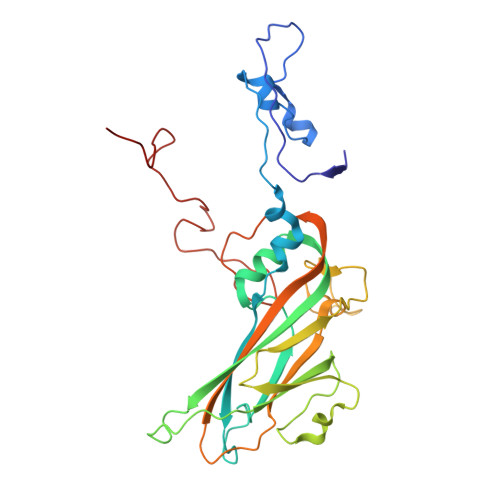
Capsid protein VP1296enterovirus D68Mutation(s): 0 
EC: 3.4.22.29 (PDB Primary Data), 3.6.1.15 (PDB Primary Data), 3.4.22.28 (PDB Primary Data), 2.7.7.48 (PDB Primary Data)
UniProt
Find proteins for A0A097BW12 (Human enterovirus D68)
Explore A0A097BW12 
Go to UniProtKB:  A0A097BW12
Entity Groups
Sequence Clusters30% Identity50% Identity70% Identity90% Identity95% Identity100% Identity
UniProt GroupA0A097BW12
Sequence Annotations
Expand
Reference Sequence
Find similar proteins by:|  3D Structure
Entity ID: 2
MoleculeChains  Sequence LengthOrganismDetailsImage
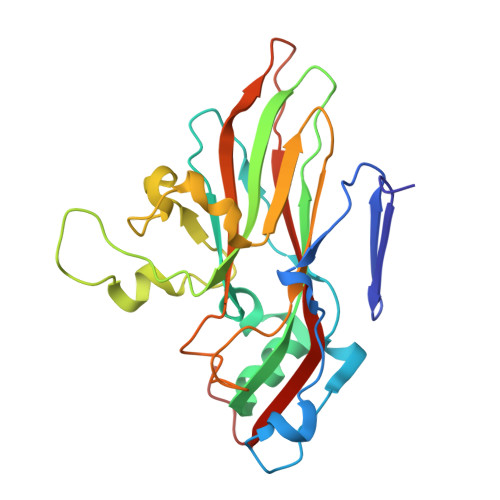
Capsid protein VP2238enterovirus D68Mutation(s): 0 
EC: 3.4.22.29 (PDB Primary Data), 3.6.1.15 (PDB Primary Data), 3.4.22.28 (PDB Primary Data), 2.7.7.48 (PDB Primary Data)
UniProt
Find proteins for A0A0C4ZN39 (Human enterovirus D68)
Explore A0A0C4ZN39 
Go to UniProtKB:  A0A0C4ZN39
Entity Groups
Sequence Clusters30% Identity50% Identity70% Identity90% Identity95% Identity100% Identity
UniProt GroupA0A0C4ZN39
Sequence Annotations
Expand
Reference Sequence
Find similar proteins by:|  3D Structure
Entity ID: 3
MoleculeChains  Sequence LengthOrganismDetailsImage
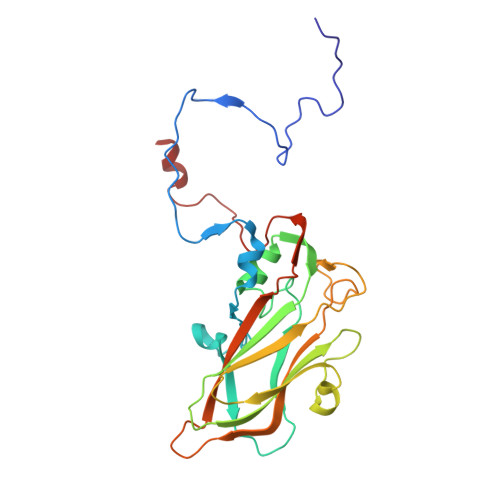
Capsid protein VP3247enterovirus D68Mutation(s): 0 
UniProt
Find proteins for A0A097BW12 (Human enterovirus D68)
Explore A0A097BW12 
Go to UniProtKB:  A0A097BW12
Entity Groups
Sequence Clusters30% Identity50% Identity70% Identity90% Identity95% Identity100% Identity
UniProt GroupA0A097BW12
Sequence Annotations
Expand
Reference Sequence
Find similar proteins by:|  3D Structure
Entity ID: 4
MoleculeChains  Sequence LengthOrganismDetailsImage
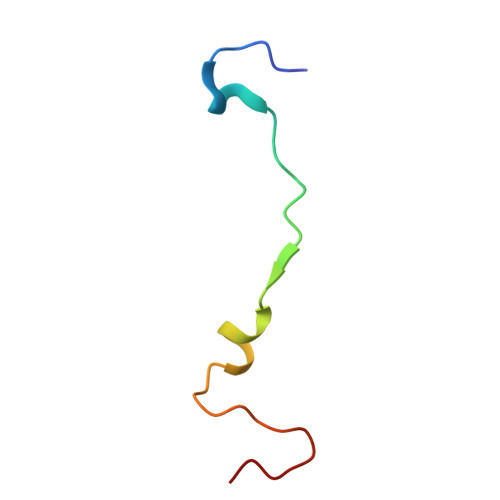
Capsid protein VP439enterovirus D68Mutation(s): 0 
UniProt
Find proteins for Q68T42 (Human enterovirus D68)
Explore Q68T42 
Go to UniProtKB:  Q68T42
Entity Groups
Sequence Clusters30% Identity50% Identity70% Identity90% Identity95% Identity100% Identity
UniProt GroupQ68T42
Sequence Annotations
Expand
Reference Sequence

Small Molecules

Ligands 1 Unique
IDChains Name / Formula / InChI Key2D Diagram3D Interactions
SPH

Query on SPH


Download:Ideal Coordinates CCD File
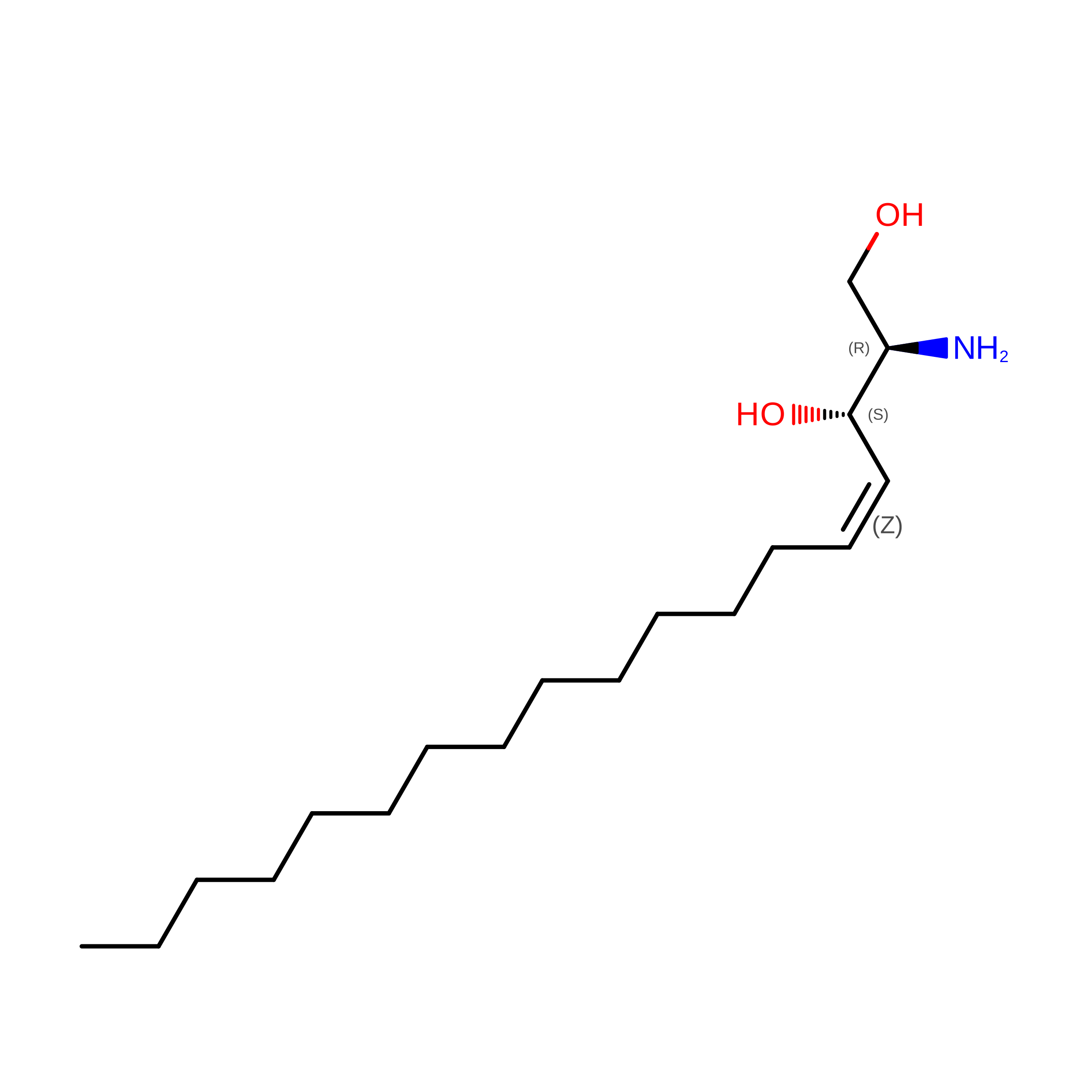
E [auth A]SPHINGOSINE
C18 H37 N O2
WWUZIQQURGPMPG-MSOLQXFVSA-N

Experimental Data & Validation

Experimental Data

  • Method: ELECTRON MICROSCOPY
  • Resolution: 2.27 Å
  • Aggregation State: PARTICLE 
  • Reconstruction Method: SINGLE PARTICLE 
EM Software:
TaskSoftware PackageVersion
MODEL REFINEMENTPHENIX1.21.2_5419
RECONSTRUCTIONcryoSPARC

Structure Validation

Currently 23AY does not have a validation slider image.


Entry History 

& Funding Information

Deposition Data


Funding OrganizationLocationGrant Number
National Natural Science Foundation of China (NSFC)China--

Revision History  (Full details and data files)

  • Version 1.0: 2026-09-09
    Type: Initial release