Download Mendeley
Benzenesulfonamide-Imidazole Hybrids as Human Carbonic Anhydrase Inhibitors.
Marcinkeviciute, J., Bagdonas, M., Vainauskas, V., Smirnov, A., Manakova, E., Mickeviciute, A., Juozapaitiene, V., Gedgaudas, M., Mickevicius, V., Matulis, D., Zubriene, A.(2026) Arch Pharm (Weinheim) 359
- PubMed: 42922365 Search on PubMed
- DOI: https://doi.org/10.1002/ardp.70369
- Primary Citation Related Structures:
31FJ, 31FK, 31FL, 31FM, 31FN, 31FO, 31FP, 31FQ, 31FR, 31FS - PubMed Abstract:
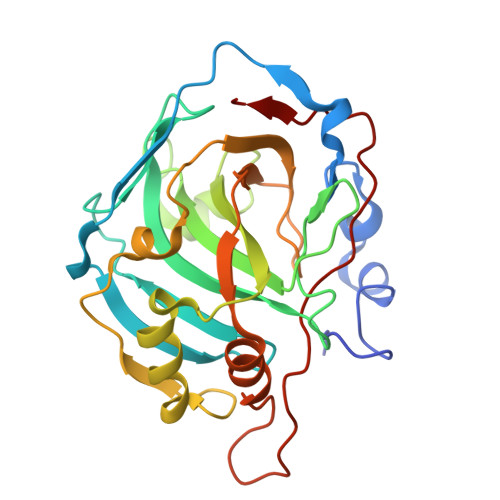
The high structural similarity among the catalytically active human carbonic anhydrase (CA) isozymes makes the identification of high-affinity, isozyme-selective ligands particularly challenging. This study investigates benzenesulfonamide-imidazole hybrids as inhibitors of CAs and explores structural features of their interactions. Binding affinity was quantified by thermal shift assay, while isothermal titration calorimetry and enzymatic inhibition assays were used to further characterize ligand-CA interactions. Most of the synthesized imidazole-bearing compounds showed high nanomolar affinity for CAII, CAVII, and CAIX isozymes, and their interactions were enthalpically favorable. Crystal structures of CA isozyme-ligand complexes indicate that hydrophobic interactions are the dominant factor in the binding of the examined benzenesulfonamide ligands (4a, 4b, 8, and 12) with CAI, CAII, CAXII, and CAXIII. Combined studies of protein-ligand binding and inhibition, and X-ray crystallography enable analysis of the structural factors responsible for high affinity, which is essential for developing more potent and selective inhibitors for a particular CA isozyme.
- Department of Biothermodynamics and Drug Design, Institute of Biotechnology, Life Sciences Center, Vilnius University, Vilnius, Lithuania.
Organizational Affiliation: