9THZ | pdb_00009thz

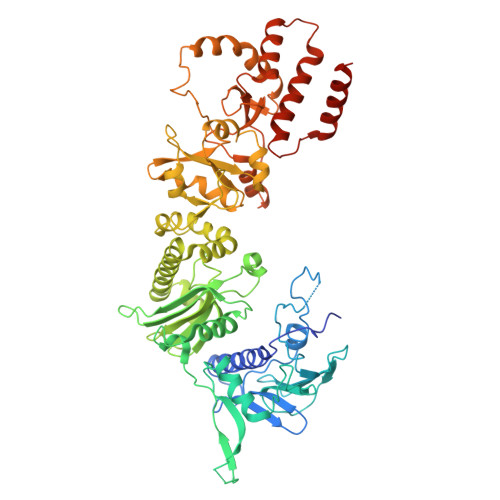
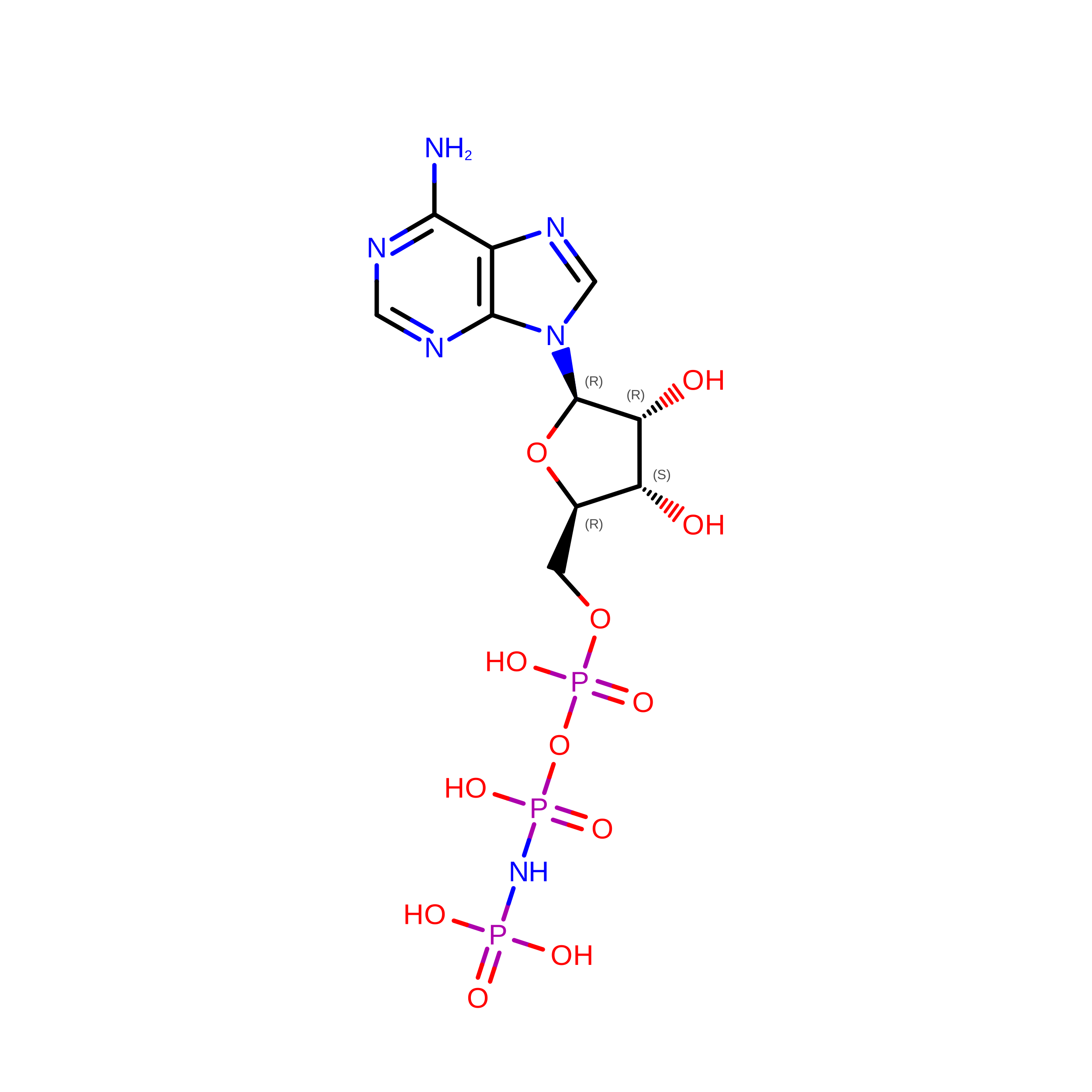
Crystal structure of HtpG chaperone in complex with AMPPNP


Experimental Data Snapshot

  • Method: X-RAY DIFFRACTION
  • Resolution: 3.32 Å
  • R-Value Free: 
    0.325 (Depositor), 0.294 (DCC) 
  • R-Value Work: 
    0.265 (Depositor), 0.273 (DCC) 
  • R-Value Observed: 
    0.268 (Depositor) 

Starting Model: in silico
View more details

wwPDB Validation 3D Report Full Report

Validation slider image for 9THZ

Ligand Structure Quality Assessment 


This is version 1.0 of the entry. See complete history. 

Literature

Structural and binding studies of the mycobacterial heat shock protein reveal a silent state and offer insights into dendritic cell activation.

Barra, G., Sala, M., Scala, M.C., Campiglia, P., Kim, H.J., Ruggiero, A., Berisio, R.

(2026) Int J Biol Macromol 353: 151218-151218

  • DOI: https://doi.org/10.1016/j.ijbiomac.2026.151218
  • Primary Citation Related Structures: 
    9THZ

  • PubMed Abstract: 

    HtpG Mtb of Mycobacterium tuberculosis is an ATP-dependent heat shock protein that assists the correct folding of nascent and stress-accumulated misfolded proteins, in concert with other chaperones. Besides playing a role in stress response, it is able to elicit an immune response against M. tuberculosis infection by activating Dendritic Cells in a Toll Like Receptor 4-mediated manner. However, we lack a full understanding of the molecular determinants of HtpG Mtb catalytic activity and Toll Like Receptor 4 activation, due to the lack of structural and biophysical data. Here, we report the first crystal structure of HtpG Mtb , in complex with the non-hydrolysable form of ATP. The crystal structure reveals that the HtpG Mtb dimer adopts a conformationally silent structure, that precludes the dimerisation of the chaperone catalytic domains needed for ATP hydrolysis. Also, binding studies show that HtpG Mtb directly interacts with Toll Like Receptor 4 with a nanomolar affinity, and that this interaction allows HtpG Mtb dimer to engage two host receptor molecules. This finding suggests that activation of Toll Like Receptor 4 by HtpG Mtb is due to its ability to induce the dimerisation of the host receptor, an essential step for initiating the entire signaling cascade.


  • Organizational Affiliation: 
    • Institute of Biostructures and Bioimaging, Italian Research Council (CNR), 80131, Naples, Italy.

Macromolecule Content 

  • Total Structure Weight: 150.19 kDa 
  • Atom Count: 9,522 
  • Modeled Residue Count: 1,209 
  • Deposited Residue Count: 1,320 
  • Unique protein chains: 1

Macromolecules

Find similar proteins by:|  3D Structure
Entity ID: 1
MoleculeChains  Sequence LengthOrganismDetailsImage
Chaperone protein HtpG
A, B
660Mycobacterium tuberculosisMutation(s): 0 
Gene Names: htpG, MRA_2316
UniProt
Find proteins for A5U4Y2 (Mycobacterium tuberculosis (strain ATCC 25177 / H37Ra))
Explore A5U4Y2 
Go to UniProtKB:  A5U4Y2
Entity Groups
Sequence Clusters30% Identity50% Identity70% Identity90% Identity95% Identity100% Identity
UniProt GroupA5U4Y2
Sequence Annotations
Expand
Reference Sequence

Experimental Data & Validation

Experimental Data

  • Method: X-RAY DIFFRACTION
  • Resolution: 3.32 Å
  • R-Value Free:  0.325 (Depositor), 0.294 (DCC) 
  • R-Value Work:  0.265 (Depositor), 0.273 (DCC) 
  • R-Value Observed: 0.268 (Depositor) 
Space Group: P 21 21 2
Unit Cell:
Length ( Å )Angle ( ˚ )
a = 173.972α = 90
b = 83.489β = 90
c = 99.096γ = 90
Software Package:
Software NamePurpose
PHENIXrefinement
autoPROCdata reduction
Aimlessdata scaling
Auto-Rickshawphasing

Structure Validation

View Full Validation Report


Ligand Structure Quality Assessment 


Entry History 

& Funding Information

Deposition Data


Funding OrganizationLocationGrant Number
NextGenerationEU-MUR PNRR Extended Partnership initiative on Emerging Infectious Diseases (INF-ACT)Italy--
PRINP2022JE8FN

Revision History  (Full details and data files)

  • Version 1.0: 2026-09-30
    Type: Initial release