Download Mendeley
Ferritin iron uptake and oxidation are dynamically modulated by nucleotide phosphate architecture via electrostatic gating.
Rajendran, A., Henley, S., Nannenga, B.L., Terashi, G., Srivastava, A., Kihara, D., Bou-Abdallah, F.(2026) Int J Biol Macromol 352: 151118-151118
- PubMed: 41763418 Search on PubMedSearch on PubMed Central
- DOI: https://doi.org/10.1016/j.ijbiomac.2026.151118
- Primary Citation Related Structures:
9Z91 - PubMed Abstract:
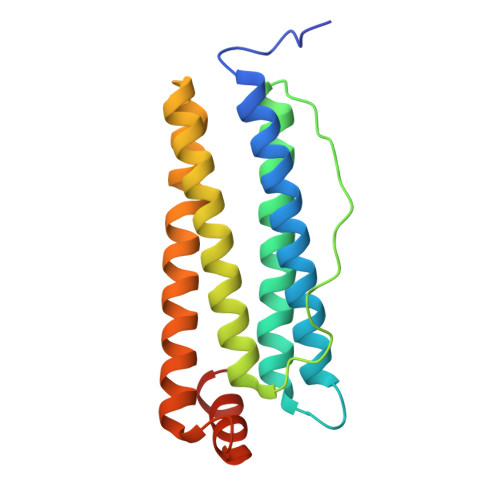
Ferritin safeguards cells from iron-induced oxidative stress by oxidizing and storing Fe 2+ within its nanocage, yet how its macromolecular architecture enables responsiveness to the cellular chemical environment remains unclear. Here, we show that ferritin's iron-oxidation activity is modulated by an electrostatic gating mechanism centered at its 3-fold channels and sensitive to solution charge conditions representative of intracellular metabolites. At physiologically relevant nucleotide concentrations, ferritin-catalyzed Fe 2+ oxidation is strongly attenuated in the presence of triphosphate nucleotides, while diphosphates and monophosphates exert progressively weaker effects, indicating that ferritin responds selectively to the charge density and geometry of the phosphate chain, rather than nucleotide identity. High-resolution cryo-electron microscopy identifies condition-dependent differences in non-protein density within and near the ferritin 3-fold channels, consistent with changes in the local solvent and/or ion environment, rather than discrete ligand binding. Fluorescence and calorimetric measurements reveal weak, reversible nucleotide association (K D ∼ 1 mM), supporting a low-affinity, dynamic electrostatic interaction mode. The inhibitory trend persists under reduced oxygen conditions and across ferritin assemblies with varying H/L composition, supporting physiological relevance across cellular oxygen tensions and native ferritin heteropolymers. Ferritin activity is similarly modulated in bacterial, yeast, and human cell lysates under near-physiological conditions, demonstrating the robustness of this behavior in complex environments. Together, these findings establish ferritin as a biological macromolecule whose intrinsic channel electrostatics enable reversible modulation of iron uptake and oxidation in response to its chemical environment.
- Department of Chemistry, State University of New York, Potsdam, NY, USA.
Organizational Affiliation: