Download Mendeley
De novo design of semisynthetic conduction pores.
Schnaider, L., Hatstat, A.K., Scott, A.J., Tan, S.K., Hambley, R.G., Dawson, W.M., Griffiths, R.C., Kormos, R.C., Melo, A.A., Tse, E., Polizzi, N.F., Wallace, E.J., Merz, G.E., DeGrado, W.F.(2026) Nat Struct Mol Biol
- PubMed: 42768128 Search on PubMedSearch on PubMed Central
- DOI: https://doi.org/10.1038/s41594-026-01881-w
- Primary Citation Related Structures:
9PN8, 9PN9, 9PNA, 9PNB - PubMed Abstract:
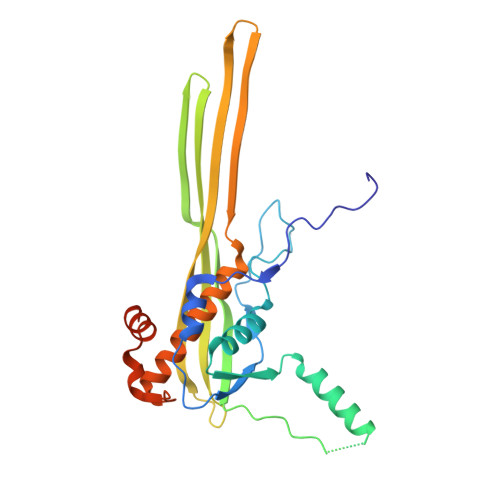
Protein pores used for molecular sensing are generally assembled from large, multi-subunit natural proteins. Their ion conductance, and thus performance in sensing applications, depends on lumen geometry and chemistry. Here rather than designing a new pore or relying only on mutations to a natural scaffold, we show that installing additional de novo subunits to native protein pore complexes enables large-scale architectural changes. We design de novo proteins that integrate seamlessly with CsgG, a pore widely used in sensing applications, to form 18-subunit, 315-kilodalton semisynthetic conduction pores. This required designing within a confined, nonuniform pore under ninefold symmetry and maintaining an open conducting lumen with a stable, low-noise baseline current. The complexes exhibit distinct current-voltage responses relative to the native pore, including clear rectification, while cryo-electron microscopy confirms the designed lumen architecture, establishing a strategy for modifying existing nano-assemblies with designed protein components under stringent symmetry and structural constraints.
- Department of Pharmaceutical Chemistry, University of California, San Francisco, CA, USA.
Organizational Affiliation: